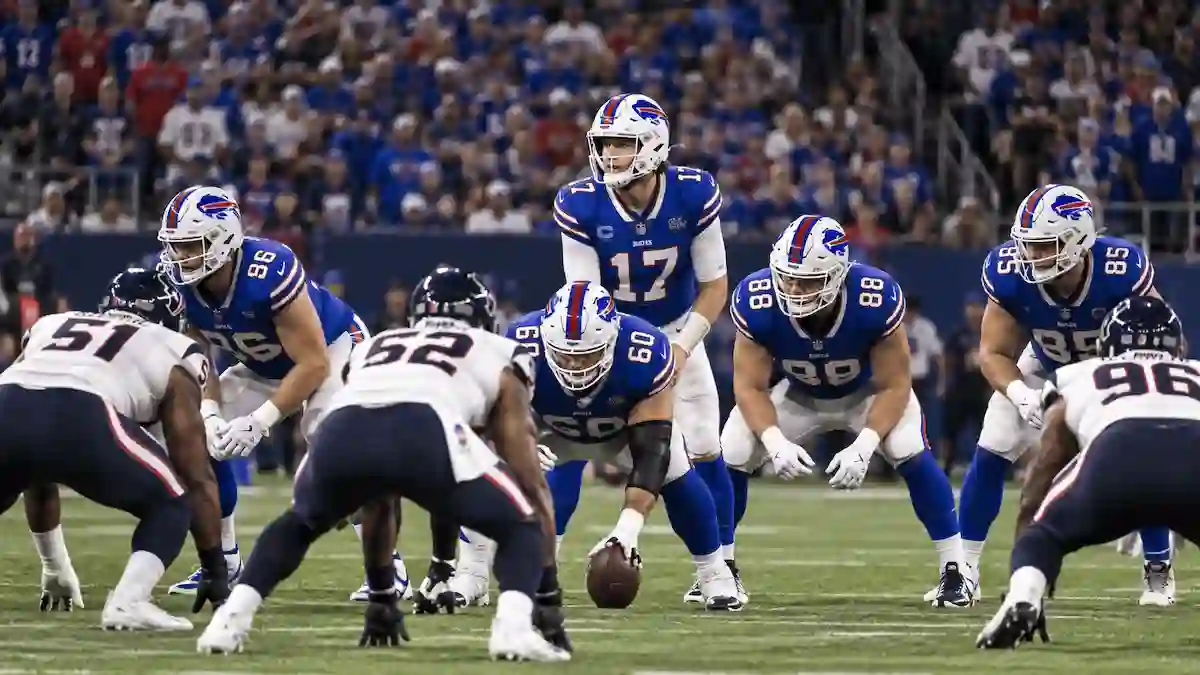
The Buffalo Bills may have quietly built one of the NFL’s most interesting offensive structures for the 2026 season, with their bills 4-TE strategy giving Josh Allen and the offense a new way to create matchup problems.
While much of the attention surrounding Buffalo has focused on Josh Allen, James Cook and the team’s wide receivers, the Bills made an unusual roster decision that could have a major impact on their offense.
Buffalo kept four tight ends on its initial 53-man roster: Dalton Kincaid, Dawson Knox, Jackson Hawes and Keleki Latu.
At the same time, the Bills carried only five wide receivers.
That does not necessarily mean Buffalo will regularly put four tight ends on the field at once. Instead, it gives offensive coordinator Joe Brady an unusually deep group of players who can line up in different positions and create matchup problems for opposing defenses.
And that could become particularly important when the Bills open the season against the Houston Texans.
Why the Bills’ 4-TE Strategy Roster Decision Matters
The first clue is the roster itself.
Buffalo’s four tight ends are not identical players. They bring different strengths as blockers, route runners and receiving options.
Kincaid is the most obvious matchup weapon. Knox provides experience and chemistry with Allen. Hawes has already shown value as a blocker who can also contribute as a receiver, while Latu gives the team another developmental option.
That combination allows Buffalo to change formations without necessarily changing personnel.
A defense could see a tight-end-heavy package and expect the Bills to run the football.
But Buffalo could also split Kincaid outside, move him into the slot or create motion before the snap.
That forces defenders to make decisions.
And against modern NFL defenses, forcing those decisions can be just as important as having another elite receiver.
Dalton Kincaid Could Be the Key
Kincaid is the player who makes this strategy especially interesting.
His 2025 season was limited by injuries and a reduced snap count, but he was extremely efficient when he was on the field.
Kincaid finished 2025 with 39 receptions for 571 yards and five touchdowns in 12 games. He also led qualified tight ends in yards per route run at 2.79, according to Buffalo-focused analysis.
The bigger clue is how Buffalo used him.
Approximately 66.9% of Kincaid’s snaps came from the slot or a wide alignment in 2025, according to Pro Football Focus data cited by Buffalo Rumblings.
That is important because it shows Kincaid does not have to behave like a traditional in-line tight end.
He can function almost like a big slot receiver.
That creates an interesting possibility for the 2026 Bills.
Instead of simply adding more wide receivers, Buffalo can use multiple tight ends and move them around the formation.
Buffalo Can Create Matchup Problems Without Changing Personnel
Imagine Buffalo lines up with three tight ends and two running backs.
The defense now has a difficult choice.
If it responds with heavier personnel, Allen could exploit slower linebackers in coverage.
If it stays in a nickel package, Buffalo can potentially attack the run or use its tight ends against smaller defenders.
And if Kincaid moves into the slot, the defense may suddenly have to treat a tight end like a wide receiver.
This is where the Bills’ roster construction becomes interesting.
The goal is not necessarily to run four-tight-end formations.
The goal could be to make the defense unsure about what the formation means.
That distinction matters.
Jackson Hawes Could Be More Important Than People Think
Kincaid gets most of the attention, but Jackson Hawes could be an important piece of this strategy.
Hawes emerged as a useful blocker and receiving option during the 2025 season. Buffalo’s increased use of three-tight-end personnel helped create situations where defenses had to respect multiple tight ends as potential receiving threats.
Buffalo Rumblings previously noted that the Bills increased their use of 13 personnel — three tight ends — during 2025, and that the package produced strong passing efficiency.
That is significant.
A traditional sixth offensive lineman can make a formation look like an obvious running situation.
A tight end who can block and catch changes the equation.
Hawes can potentially help Buffalo maintain the physicality of the formation without making the passing threat disappear.
The Texans Are the Perfect Week 1 Test
This strategy could immediately face a major challenge.
The Bills open the regular season against the Houston Texans, a defense that has already demonstrated an unusual ability to pressure quarterbacks without relying heavily on blitzes.
Houston had the NFL’s lowest blitz rate at 16.7% in 2025, yet still produced a 40.3% pressure rate, according to Buffalo-focused analysis.
The previous Bills-Texans matchup provides an even stronger warning.
Houston pressured Allen on 43.5% of his dropbacks while blitzing only 15.2% of the time. The Texans generated seven of their eight sacks without blitzing.
That is exactly the type of defense that can make an offense uncomfortable.
If Houston can generate pressure with its normal four-man rush, Buffalo has fewer opportunities to punish aggressive blitzes.
The Bills therefore need ways to create quick reads and prevent Houston’s pass rush from controlling the game.
That is where tight ends could become extremely valuable.
Could Kincaid Become Allen’s Pressure-Release Weapon?
One potential solution is getting Kincaid involved quickly.
If Houston uses four-man pressure, Allen can potentially attack the space underneath with Kincaid, Knox or Hawes before the pass rush arrives.
That does not require Kincaid to become the team’s No. 1 receiver.
Instead, he could become the player who makes Houston pay for certain defensive looks.
Motion can also help Allen identify coverage before the snap.
If Kincaid moves across the formation and a defender follows him, Allen gets information about the coverage.
If the defense does not follow, Buffalo may get an indication that zone coverage is coming.
Those small details can matter against a defense that does not need to blitz to create pressure.
Josh Allen Gives Buffalo Another Advantage
The strategy becomes even more dangerous because of Allen.
Defenses already have to account for his arm strength and scrambling ability.
That makes personnel-heavy formations particularly interesting.
If Buffalo puts multiple tight ends on the field, the defense cannot automatically assume it will be a conventional run.
If defenders hesitate, Allen can attack through the air.
If they spread out, James Cook can become more dangerous on the ground.
And if the pocket breaks down, Allen remains one of the NFL’s most dangerous quarterbacks outside structure.
The tight ends therefore do not need to dominate statistically for the strategy to work.
Their presence can simply force defenses to make harder decisions.
This Could Be Buffalo’s Hidden Offensive Advantage
The most interesting part of the Bills’ roster decision is that it gives Joe Brady flexibility.
Buffalo can still use traditional three-receiver formations.
But the team now has another route to create mismatches.
A 12-personnel package with two tight ends can look completely different depending on where Kincaid lines up.
A three-tight-end package can force a defense to choose between size and speed.
And an occasional four-tight-end look could create an even bigger personnel dilemma.
Again, the important point is not that Buffalo will suddenly become a four-tight-end offense.
There is not enough evidence to make that claim.
The more reasonable conclusion is that Buffalo has intentionally built a tight-end room deep enough to make multiple personnel groupings a legitimate part of its offensive identity.
That could be the real story.
What to Watch in Bills vs. Texans
There are five things worth watching when Buffalo faces Houston.
1. Kincaid’s Snap Share
Kincaid played only about 26.7% of Buffalo’s offensive snaps in 2025 according to Pro Football Reference.
If that number jumps significantly in Week 1, it will be an early indication that Buffalo’s offensive plan has changed.
2. Three-Tight-End Personnel
Watch how frequently Buffalo uses Kincaid, Knox and Hawes together.
That could provide the clearest evidence of whether the Bills are leaning into this concept.
3. Kincaid’s Alignment
The most important question may not be how many snaps Kincaid plays.
It may be where he lines up.
If he repeatedly moves into the slot or outside, Buffalo is treating him as a matchup weapon rather than simply another tight end.
4. Houston’s Response
Will the Texans use heavier personnel?
Will they stay in nickel?
Will a linebacker cover Kincaid?
Those answers could reveal whether Buffalo has found a weakness.
5. Josh Allen’s Time to Throw
The ultimate test is whether the formation helps Allen get the ball out before Houston’s pass rush arrives.
If Buffalo can create easy completions early, it could force Houston to change its defensive plan.
The Bottom Line
The Buffalo Bills’ decision to keep four tight ends may look like a small roster detail.
It could turn out to be much more important.
Dalton Kincaid gives Buffalo a versatile receiving weapon. Dawson Knox provides experience. Jackson Hawes adds blocking ability and another receiving threat. Keleki Latu gives the group additional depth.
More importantly, the collection gives Joe Brady flexibility.
Buffalo does not need to become an offense that lives in four-tight-end formations.
It simply needs to make defenses wonder what those tight ends are going to do next.
Against a Houston defense that generated pressure without heavy blitzing last season, that flexibility could become especially valuable.
If Kincaid stays healthy and Buffalo consistently uses its tight ends to create mismatches, the Bills may have discovered an offensive advantage that has received far less attention than Josh Allen’s superstar status.
The Bills will also need to keep a close eye on player availability heading into Week 1. Check the latest NFL Week 1 injury report for the newest updates.
The 2026 Bills’ biggest offensive change may not be a new receiver or a new quarterback. It may be how they use the tight ends already on the roster.
FAQs
How many tight ends did the Bills keep on their 2026 roster?
Buffalo kept four tight ends on its initial 53-man roster: Dalton Kincaid, Dawson Knox, Jackson Hawes and Keleki Latu.
Will the Bills use four tight ends on every play?
No. Keeping four tight ends does not mean Buffalo will regularly use four-TE formations. The more likely advantage is having enough depth to use multiple tight-end personnel packages and move players such as Kincaid around the formation.
Why is Dalton Kincaid important to the Bills’ offense?
Kincaid provides receiving ability from a tight-end position and has frequently been used away from the traditional in-line tight-end alignment. In 2025, a large majority of his snaps came from slot or wide alignments.
How did Kincaid perform in 2025?
Kincaid recorded 39 receptions for 571 yards and five touchdowns in 12 games during the 2025 season.
Why are the Texans a difficult matchup for Josh Allen?
Houston generated a 40.3% pressure rate in 2025 despite blitzing at the NFL’s lowest rate of 16.7%. The Texans also pressured Allen on 43.5% of his dropbacks in their previous matchup.