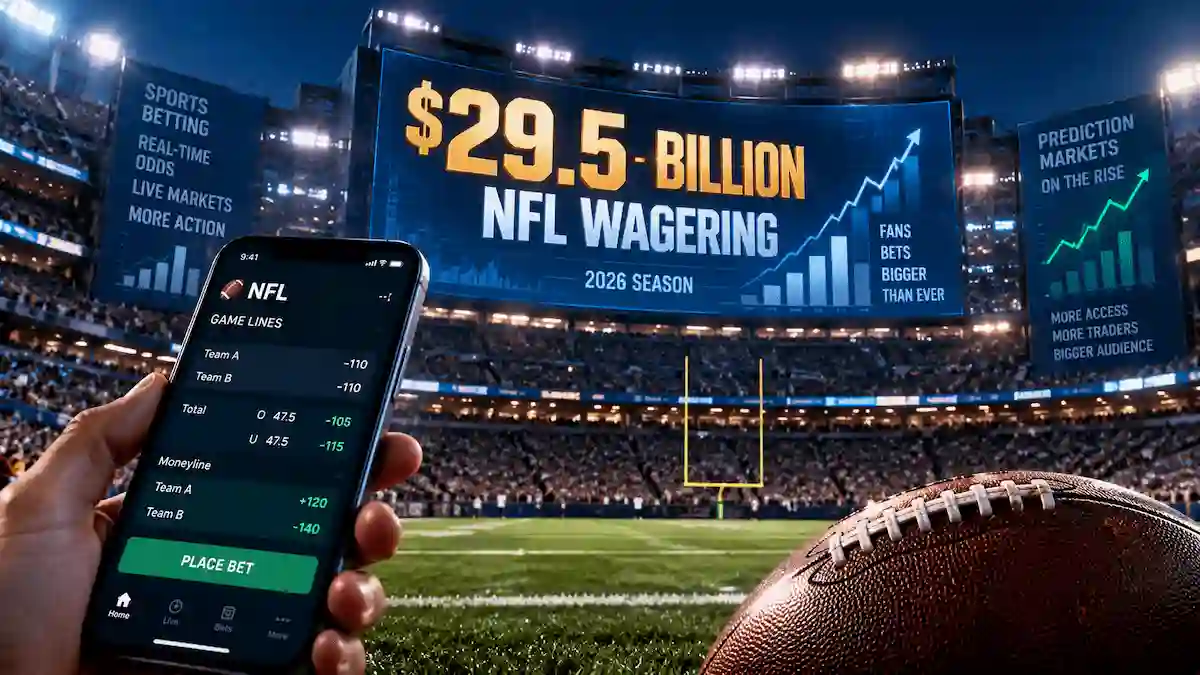
The NFL betting market is heading into the 2026 season with a surprising forecast. According to the American Gaming Association (AGA), Americans are expected to legally wager approximately $29.5 billion through regulated U.S. commercial sportsbooks during the 2026 NFL season.
While the number sounds enormous, there is one major detail that stands out: the projection represents almost no year-over-year growth.
The AGA estimates that the 2026 NFL betting handle will reach $29.5 billion, compared with approximately $29.4 billion during the previous season. That means the traditional regulated sports betting market could be entering a period of much slower growth.
At the same time, the AGA says rapidly expanding prediction markets are changing the competitive landscape and attracting significant sports wagering activity across the United States.
NFL Betting Growth Could Be Stalling
Since the U.S. Supreme Court overturned the federal sports betting ban in 2018, legal wagering has expanded dramatically across the country.
Millions of American sports fans now have access to regulated sportsbooks, depending on the laws in their state. The NFL has been one of the biggest beneficiaries of that expansion because football remains one of the most popular sports for bettors.
However, the AGA believes the market is now entering a different phase.
The organization’s latest estimate suggests that regulated NFL betting handle will remain essentially flat in 2026.
AGA President and CEO Bill Miller said the situation is different this year because of the widespread growth of prediction markets offering contracts connected to sporting events.
According to the AGA, the expansion of these platforms could be diverting wagering activity away from traditional regulated sportsbooks.
Prediction Markets Become a Major Talking Point
Prediction markets have rapidly become one of the biggest stories in the U.S. sports wagering industry.
Platforms such as Kalshi and Polymarket have expanded their offerings to include contracts tied to sports outcomes. The AGA argues that these products can function similarly to sports wagers while operating under a different regulatory structure.
This has created a major debate over how sports-related prediction contracts should be classified and regulated.
The AGA says prediction markets are effectively offering sports betting products across states where traditional sports wagering may not be permitted.
That distinction is at the center of the current industry dispute.
Traditional sportsbooks operate under state and tribal regulatory systems in jurisdictions where sports betting has been legalized. Prediction-market operators, meanwhile, argue that their contracts fall under a different federal regulatory framework.
The disagreement could become increasingly important as the NFL season progresses.
AGA Estimates $29.5 Billion in NFL Wagering
The AGA’s $29.5 billion projection includes more than just regular-season games.
Its methodology incorporates:
- NFL preseason games
- Futures wagers
- Regular-season games
- NFL playoffs
- Super Bowl LXI
- Futures booked as early as March
The organization calculated the projection using national sports betting growth during 2026 and football-specific reporting from selected states.
The final estimate is therefore intended to represent the total amount expected to be wagered on professional football throughout the full NFL season.
Despite the massive dollar figure, the lack of meaningful growth is what makes this year’s forecast particularly notable.
Why the Flat Growth Matters
A $29.5 billion betting handle may look like another record-level figure at first glance. However, the comparison with last season tells a different story.
The previous estimate was approximately $29.4 billion.
That means the projected increase is only around $100 million, or roughly 0.3%.
For an industry that experienced rapid expansion following the legalization wave that began after 2018, such a small increase represents a dramatic slowdown.
There are several possible reasons.
The regulated market is becoming more mature, meaning sportsbooks can no longer rely on the explosive growth seen during the industry’s early expansion.
Competition between sportsbooks is also intense, while prediction markets are introducing another avenue for consumers interested in sports-related contracts.
The AGA believes this combination is contributing to the slowdown.
Kalshi and Prediction Markets Draw Attention
The AGA specifically highlights the growth of sports contracts on prediction-market platforms.
According to the organization, sports bets represent roughly 80% of Kalshi’s volume.
The AGA also estimates that approximately $5.1 billion in Kalshi volume comes from users between the ages of 18 and 20.
That figure has become another major concern for the traditional gaming industry because the legal gambling age for sports betting is higher than 18 in many jurisdictions.
The AGA says the activity raises questions about consumer protections, responsible gaming standards and regulatory oversight.
However, the broader legal and regulatory status of sports-related prediction markets remains an evolving issue, making the debate one of the most important stories to watch throughout the 2026 NFL season.
Billions in Tax Revenue at Stake
The debate is not only about sportsbooks and prediction-market companies.
There is also a significant financial issue for state governments.
The AGA says the regulated gaming industry supports approximately 1.8 million jobs and generates substantial tax revenue that can support education, infrastructure and public services.
The organization estimates that prediction markets such as Kalshi and Polymarket have already diverted more than $1.3 billion in potential state gaming tax revenue since 2025.
The AGA argues that traditional sportsbooks are required to follow state regulations and contribute gaming taxes, while prediction-market operators can compete in the sports wagering space under a different regulatory model.
That difference could become even more significant if sports prediction contracts continue to grow.
What NFL Fans Should Know
For NFL fans, the biggest takeaway is that the sports wagering landscape is changing quickly.
Consumers now have several different types of platforms available to them, but they are not necessarily governed by the same rules.
The AGA is encouraging bettors to understand the difference between:
- Licensed sportsbooks
- State- and tribal-regulated operators
- Prediction-market platforms
- Illegal betting operators
.
The organization recommends using legal and regulated operators and understanding the protections that apply in the user’s jurisdiction.
For consumers, the regulatory distinction can affect everything from age requirements to responsible gaming protections and dispute resolution.
What Happens Next for NFL Betting?
The 2026 NFL season could become an important test for the future of American sports wagering.
If the AGA’s $29.5 billion projection is accurate, traditional NFL betting could experience its slowest growth period since the nationwide expansion of legal sports wagering began.
Meanwhile, prediction markets could continue pushing deeper into sports.
That creates a potentially important turning point.
If prediction-market sports contracts continue gaining popularity, traditional sportsbooks, regulators and lawmakers may face increasing pressure to determine whether these products should be treated differently from conventional sports bets.
For now, the numbers tell a clear story: NFL betting remains enormous, but its growth has slowed dramatically.
The projected $29.5 billion handle shows that Americans are still wagering billions on professional football. But the rise of prediction markets could fundamentally change where that money is being placed—and how the industry is regulated.
As the 2026 NFL season gets underway, the battle between traditional sportsbooks and prediction markets may become almost as important to watch as the games themselves.